Allison Parrish
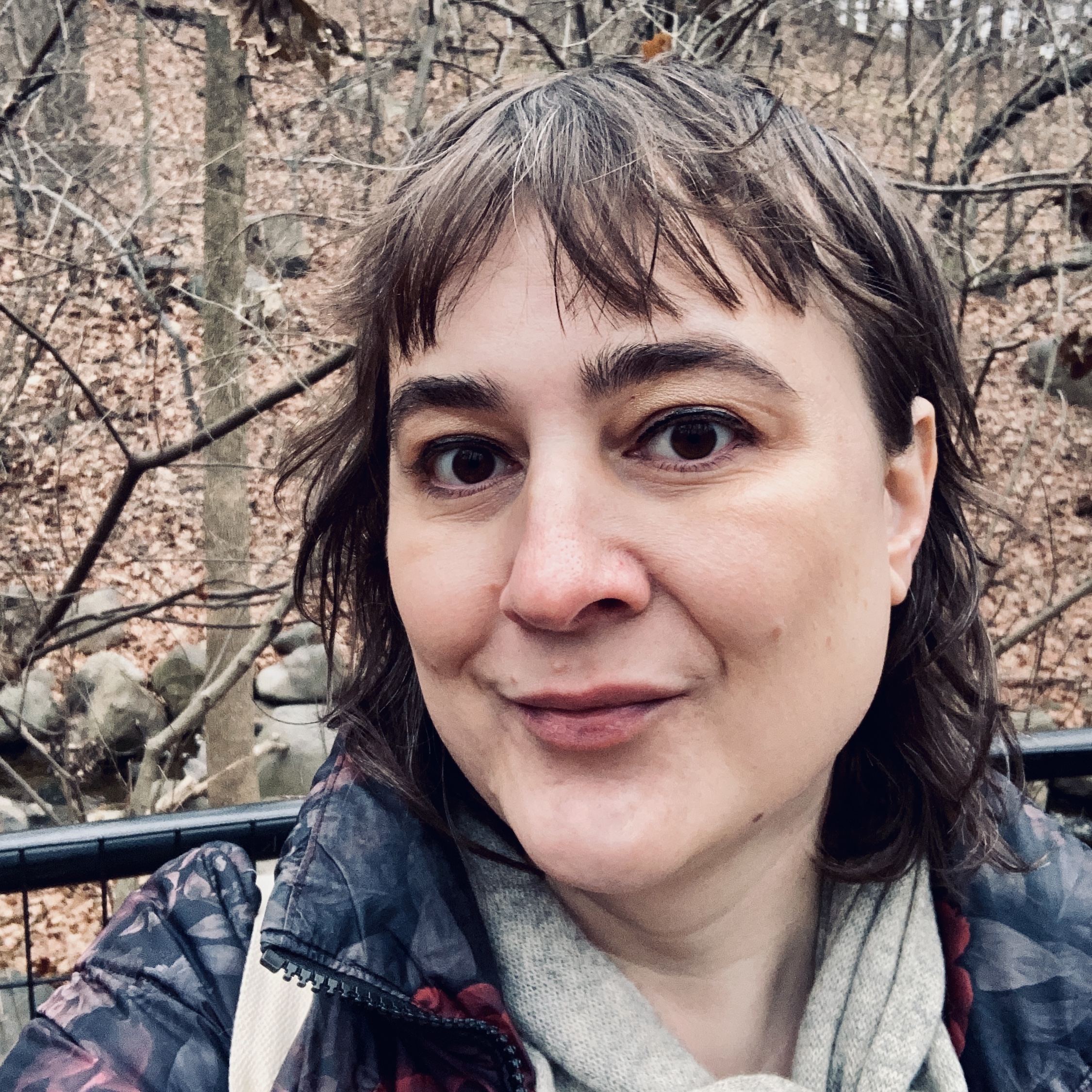
Allison Parrish is a computer programmer, poet, and game designer whose teaching and practice address the unusual phenomena that blossom when language and computers meet. She is an Assistant Arts Professor at NYU’s Interactive Telecommunications Program.
According to Ars Technica, Allison’s work “delight[s] everyone.” She was named “Best Maker of Poetry Bots” by the Village Voice in 2016, and her zine of computer-generated poems called “Compasses” received an honorary mention in the 2021 Prix Ars Electronica. Allison is the co-creator of the board game Rewordable (Clarkson Potter, 2017) and author of several books, including @Everyword: The Book (Instar, 2015) and Articulations (Counterpath, 2018). Her poetry has recently appeared in BOMB Magazine and Strange Horizons.
Allison is originally from West Bountiful, Utah and currently lives in Brooklyn.
Artist Statement
Why is the work that the New Frameworks project is working to preserve important to you?
I try to make resources that are useful to people, enrich the commons, and reflect/reproduce my values, and I think the Gutenberg Poetry Corpus is a good attempt at that. Moreover, the makers of commercial generative AI are forcibly drawing artists’ and poets’ attention away from any of that technology’s material underpinnings, including its training data. I hope my little act of building a corpus for poets from the public domain counteracts this trend a little.
What are the key ideas, issues, struggles, goals within your work?
We subject language to abstractions, and then laws (based on those abstractions) that dictate proper language use, and also set a boundary around language’s affordances. As a computer programmer, I’m a student of how digital technology enforces particular abstractions of language (and therefore particular laws); as a poet, I want to demonstrate how those abstractions are contingent. I’m especially interested in the effect that language has on the body, and the pleasure it provokes, in both speaker and listener, outside of its conventional purpose (i.e., conveying meaning).
Who is your audience?
I try to be playful and make work that wears its own production on its sleeve. Sometimes I don’t manage to pull it off, though. I think my audience is people who speak English but don’t take it too seriously.
Who are your biggest artistic influences?
lots of folks but the poet whose work I’m always turning back to is Jackson Mac Low
Preservation Sketch
Read how we preserved Allison Parrish’s work, Gutenberg, dammit.